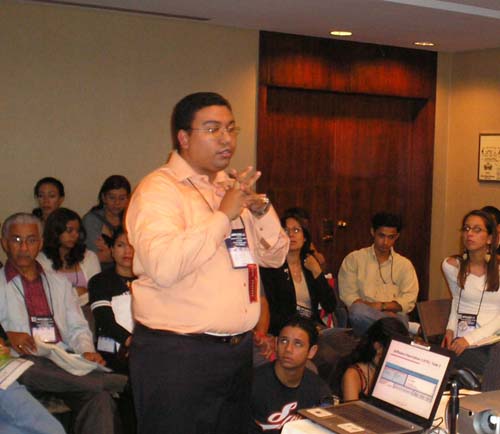
It has been a week already! I delivered my presentation Diversity and Disability: Are teachers up for social change outside the classroom? in RSCON#4. After this, I have been wondering what’s ahead for our role as agent of social change when it comes down to providing support to students with disabilities inside or/and outside the classroom. You will be amazed by how many teachers think they have no responsibility whatsoever for helping these students. Some of them verbalize it; some others go with their actions. Now this might have its reasons. What talks or shows, in my opinion, is the lack of training and the fear of not knowing what to do when a student with disability is in their classroom. What talks or shows, in my opinion, is this construct of “normalcy” we have of a “person”, a “human being”, a student. What talks or shows, in my opinion, is the programming we have been subjected to since childhood about people with disabilities. Being different is off; being like everybody else rocks. As a result, stereotypes and the lack of proper training win. These students are, then, marginalized. They become invisible in the classroom. Fortunately, there are some other teachers who think otherwise. In my presentation, I reflected in a loud voice about my experience with students with disabilities outside the classroom as part of a support group created back in 2004 in the School of Librarianship. This is one of 10 schools in the Faculty of Humanities and Education at Universidad Central de Venezuela. I started off by acknowledging the initiatives I have noticed over the last couple of years about diversity and minorities groups like the LBGT community and people with disabilities. For the latter group, a very good example is the work done by the Disabled Access Friendly or posts like the ones written in the iTDi blog on Special Needs or the one written by Patrick Jackson, Hey, teacher! What are YOU for? And what about the amazing work people from Northern Arizona University are doing with their Disability Awareness Week! That definitely brings hope. But there’s still a lot to do. Also, during my talk, I shared my experience as part of CAEDEBA (a
 committee that offers support to students with disabilities from the School of Librarianship). It focuses on academic support and raising awareness activities. It has been on the road for 9 solid years. Towards the end of the presentation, I asked participants if they believe teachers were ready to bring about social change to help guarantee integration and inclusion of students with disabilities inside and outside the learning environment. Also, I told them what I believe are the benefits of providing support to students with disabilities outside the classroom and sketched out what they have to take into account if they would like to create a similar support group. I ended up the session showing them it is not that easy to identify when a student has a disability. Perhaps, this happens because we generally tend to focus on the disability and not the PERSON.
RSCON# 4 was the perfect platform to talk about this. This year, most sessions and keynotes in RSCON were focused on technology. But it was interesting to see some of them were not (Cecilia Lemus, Leo Selivan, Gallit Zvi, Tamas Lorincz, Malu Sciamarelli, Barbara Hoskins Sakamoto , Chuck Sandy among others).
 As far as I know, all four RSCONs have focused its attention on the future of education. "Diversity" and learning to teach and deal with students with disabilities inside and outside the classroom are part of that future. I see a more inclusive classroom with inclusive and accessible teachers and classmates as well as all the members of this educational community (school, high school, university). A place where we will focus on the person and not on “the lacking of…” Disability in education should not equal to “dumb”, “limited”, “slow”. This only shows a narrow concept of what a PERSON is. It only shows we do not acknowledge the differences or do not know what to do with them. I am not talking about special treatment (medical model), but equal opportunities (social model). I am not talking about pitying (medical model), but adapting content (social model) . Provide them with opportunities and they will success or not just like any other student (social or functional diversity model). It is true we have to consider the potential learning and the type of disability the student has before they are granted a place at the university. This information will be important for both: the students and the university he is applying for. In our country, most of them can get a place from a government modality without having a thorough evaluation (skills, competency and disability) or a counseling session (Why he she chose this or that career?) creating sometimes false expectations in the students and his/her parents. Now this responsibility falls into those who provide access to students with disabilities at the university. Anyway, If they get a place at the university, we should find the way to help guarantee equal opportunities.
On the other hand, universities or institutions training teachers should include in their curriculum a subject or course related to diversity and disability. Also, all universities public or private should consider in their curricula a subject or course related to disabilities to train or sensitize undergraduates students about it. As graduates, they may have to deal with people with disabilities at some point at work.
As language teachers, I do believe our responsibility goes beyond the perfect lesson or
 choosing the right method, approach, or methodology. If there’s a student with Asperger's syndrome in our class and we would like to use / explore this DOGME methodology, do we know it is very likely he/she could start to feel really anxious if they are not provided a structure to respond positively to this metholody? How can we adopt this methodology to include this student and guarantee he will get the most of it as the rest of the students?

Without this RCON session, I think I wouldn’t have sat to reflect and even talked about this to ESL/EFL teachers. Something I believe I should have done a long time ago. I will finish this post by sharing a snippet from Patrick’s article: “...education is not just about acquiring skills and knowledge but that it also embraces social improvement. Teachers are in a unique position to impact on the future through their teaching of well being, fairness, equality and truth.”
Here's my presentation and the recording. October 12th, 2013. 2 p.m. Venezuela time.
Here's my presentation and the recording. October 12th, 2013. 2 p.m. Venezuela time.

"You all laugh because I'm different...I laugh because you're ALL the same." Jonathan Davis
All images: Miguel Mendoza by Miguel Mendoza is licensed under a Creative Commons Attribution-NonCommercial-NoDerivs 3.0 Unported License - See more at: http://miguelmendozaefl.blogspot.com/#sthash.yFUyJxlD.dpuf
All images: Miguel Mendoza by Miguel Mendoza is licensed under a Creative Commons Attribution-NonCommercial-NoDerivs 3.0 Unported License - See more at: http://miguelmendozaefl.blogspot.com/#sthash.yFUyJxlD.dpuf
These images Miguel Mendoza by Miguel Mendoza is licensed under a Creative Commons Attribution-Non-Commercial No Derivs 3.0 Unported License