Once a community of practice has been set up, a series of events are going to take place as a result of the interaction among the members of this community. This forming or building of the community can be explained by using Gilly Salmon’s five-model step (2005). This model is based on a research carried out by Gilly Salmon in the Open University of the United Kingdom. A group of teachers and students from the Master of Business Administration from the OU participated in this research using computer mediated conferencing (CMC) during the early 90’s. This experience helped Gilly Salmon build her model of teaching and learning online. For Salmon, it’s important to understand that learning online is more than just using a computer. It implies complex interaction, transformation and integration of ICT skills while learning about a topic. Salmon’s model is divided into 5 stages represented as a flight of steps.
Stage one: Access and motivation E-moderator welcomes, encourages people to participate in the community and offers technical support for participants to get online. Participants need access to a computer; internet, have at least certain basic notions on how to go about in an on-line environment, time and effort. Individual support is needed at this stage.
Stage two: Online socialization Participants start sending and receiving messages. Participants get to know each other (High social component). They become familiar with the new online environment. E-moderators is responsible for promoting and keeping online socialization and networking. He is also responsible for helping participants understand how they can help each others to enhance their knowledge related to a topic, course or discipline. The development of a new culture gradually emerges in this stage with rules, norms of behaviors, ways of operating and sanctions. Social scaffold and promoting respect are keywords in this stage!
Stage three: Information exchange Participants start exchanging information which can be quite overwhelming but they will have to learn with it by developing certain strategies. At this stage, also participants have already quite defined roles in the community. The e-moderator helps participants deal with the quantity of information shared and helps them focus on finding answers to problems or issues arising in the exchanges. Learning to deal with “messiness” (amount of information coming from different participants during this stage) .
Stage four: Knowledge construction Participants interact and participate more. Participants learn more by expanding their knowledge and realizing that there are different perspectives to understand a problem or issue. E-moderators become less active. He becomes a kind of a “weaver” of knowledge. For example, they collect participants’ messages and relate them with theories and concepts related to the debate or discussion taking place in the community. At this stage, anyone can become the moderator temporarily; steps back and another member of the community take the lead. E-moderators should have clear the difference between cognitive methods of teaching and learning and constructivist approaches.
Stage five: Development Participants become responsible for their own leaning and need less support from others. They reflect on how they have learned in the community and what they needed to do so (metacogniton). E-moderators promote critical thinking among the members of the community.
Uncertainties and problems may arise as a result of discussion at this stage.
This is just a summary of Gilly Salmon’s model. It’s important to say that technical support, e-moderation and a purpose for participating in a community are a must for a community to succeed (Salmon, 2005).
Salmon, Gilly (2005). E-moderating: the key to teaching & learning online. RoutledgeFalmer. London & New York. All Things in Moderation - E-moderating, 2nd edition. Retrieved July 19, 2006, from http://www.atimod.com/e-moderating/5stage.shtml

Showing posts with label COPs. Show all posts
Showing posts with label COPs. Show all posts
Sunday, May 07, 2006


Tuesday, April 11, 2006
Communities of Practice (CoPs)
I`d like to start this entry by saying that there’s nothing like sharing and learning from others. Knowledge should not be a secret kept by someone who jealously guards a treasure to which only him/her have access to. What others do or know can be a source of inspiration for others to do things they don’t know how to. Also, this knowledge can be improved or adapted (not adopted!) to fit into people’s different environments or their specialized professional areas. This sharing and learning could be more effective if it takes place in an environment or medium devoid of the cold, formal professional or academic demands or discourse imposed by experts that more often than not shoo away the active, valuable participation of the members of a certain community. Such an environment is not a figment of my imagination.
Currently, we can share and learn from others in the so called Communities of Practice (Cops). I heard about it in the seminar I attended last February, ICT in ELT: putting the 'Learning' back into 'E-Learning' (2006) and I would like to share what I learned about it with you.
Well, a good start would be providing some definitions about CoPs. CoPs definitions Nicholson (2000): "Communities of Practice (CoPs) are groups of people in organizations that form to share what they know, to learn from one another regarding some aspects of their work and to provide a social context for that work."
Gavin Dudeney (2006) Gavin Dudeney, seminar event director, gave us some definitions related to communities of practice. He referred to two types of CoPs: physical and distributed ones. The former refers to “a group of people who share an interest in something, and come together to develop knowledge around this topic, in order to use it in practice.” (Wenger, 1991). The latter to “…a distributed community of practice (CoP) consists of a group of people who communicate with each other synchronously and/or asynchronously, concerning a topic of common interest.” (Jones, 2002).
The next definition is taken from Wenger’s site and I kind of like this one a lot: “Communities of practice are groups of people who share a concern or a passion for something they do and learn how to do it better as they interact regularly.”
These concepts have got in common words like “learn”, “share”, “interact”, “things in common”. I would dare to add that interactions in CoPs are done without the constraints and demands that formal contexts imposed on people and that generally prevent them from contributing authentic and valuable information. This information could enhance their practices which will have a direct impact in the environments they work in. In education, especially EFL in our country, are in need of being nurtured and seeded by the expertise of others. Universities seem to develop knowledge which stays at universities. Same thing seems to apply to state schools. The only moment we seemed to share is in few EFL events like TESOL. But then again knowledge gets there, we don’t know what happens afterwards. Do people apply what they learn in these events? If so, how? Is it any better? If they couldn’t, why? Can we help? Is it possible to start networks that keep EFL teachers in contact to share and end up producing something that gives coherence to our curriculums all along the country?
Characteristics of Cops Gavin Dudeney’s presentation during the seminar was not only restricted to definitions but to examples of CoPs like Webheads in action and some aspects that characterize these communities. Click on the word chart below to see these characteristics. In this CHART you will see:
1) Type of communication used among members
2) How CoPs are organized
3) The knowledge domain in this type of communities
4) What members do in CoPs
5) Approach CoPs is based on
6) Tool used to set up CoPs
7) Stages CoPs go thorough
If you want to learn more about Cops, I recommend you to go to:
Communities of Practice a brief introduction
A 1-page quick guide by Etienne Wenger
Communities of practice
Communities of practice
Stephen Powell’s blog
Facilitating and hosting virtual commnunities
Some considerations for facilitating online interaction
Communitiy members roles and types
Using content to support your commnuity
Building online communities for high-profile Internet sites
Currently, we can share and learn from others in the so called Communities of Practice (Cops). I heard about it in the seminar I attended last February, ICT in ELT: putting the 'Learning' back into 'E-Learning' (2006) and I would like to share what I learned about it with you.
Well, a good start would be providing some definitions about CoPs. CoPs definitions Nicholson (2000): "Communities of Practice (CoPs) are groups of people in organizations that form to share what they know, to learn from one another regarding some aspects of their work and to provide a social context for that work."
Gavin Dudeney (2006)
 Gavin Dudeney, seminar event director, gave us some definitions related to communities of practice. He referred to two types of CoPs: physical and distributed ones. The former refers to “a group of people who share an interest in something, and come together to develop knowledge around this topic, in order to use it in practice.” (Wenger, 1991). The latter to “…a distributed community of practice (CoP) consists of a group of people who communicate with each other synchronously and/or asynchronously, concerning a topic of common interest.” (Jones, 2002).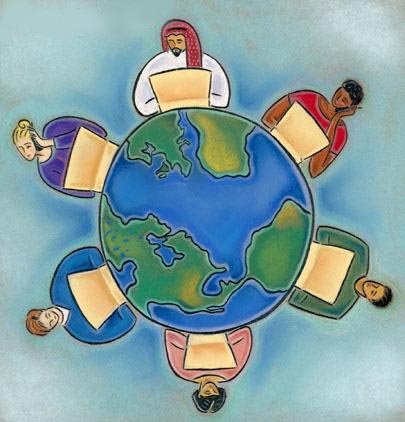
The next definition is taken from Wenger’s site and I kind of like this one a lot: “Communities of practice are groups of people who share a concern or a passion for something they do and learn how to do it better as they interact regularly.”
These concepts have got in common words like “learn”, “share”, “interact”, “things in common”. I would dare to add that interactions in CoPs are done without the constraints and demands that formal contexts imposed on people and that generally prevent them from contributing authentic and valuable information. This information could enhance their practices which will have a direct impact in the environments they work in. In education, especially EFL in our country, are in need of being nurtured and seeded by the expertise of others. Universities seem to develop knowledge which stays at universities. Same thing seems to apply to state schools. The only moment we seemed to share is in few EFL events like TESOL. But then again knowledge gets there, we don’t know what happens afterwards. Do people apply what they learn in these events? If so, how? Is it any better? If they couldn’t, why? Can we help? Is it possible to start networks that keep EFL teachers in contact to share and end up producing something that gives coherence to our curriculums all along the country?
Characteristics of Cops Gavin Dudeney’s presentation during the seminar was not only restricted to definitions but to examples of CoPs like Webheads in action and some aspects that characterize these communities. Click on the word chart below to see these characteristics. In this CHART you will see:
1) Type of communication used among members
2) How CoPs are organized
3) The knowledge domain in this type of communities
4) What members do in CoPs
5) Approach CoPs is based on
6) Tool used to set up CoPs
7) Stages CoPs go thorough
If you want to learn more about Cops, I recommend you to go to:
Communities of Practice a brief introduction
A 1-page quick guide by Etienne Wenger
Communities of practice
Communities of practice
Stephen Powell’s blog
Facilitating and hosting virtual commnunities
Some considerations for facilitating online interaction
Communitiy members roles and types
Using content to support your commnuity
Building online communities for high-profile Internet sites
Thursday, March 02, 2006
SEMINAR: ICT in ELT: putting the 'Learning' back into 'E-Learning' (2006)
 |
| Photograph by Meer Sild from Estonia |
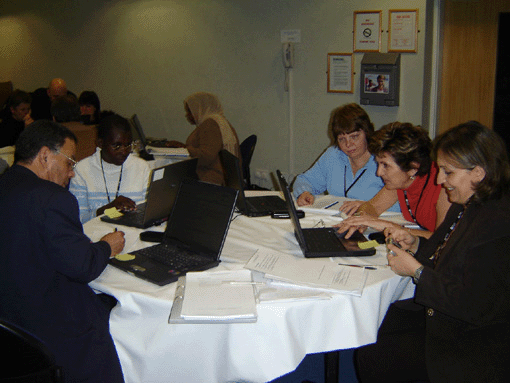
This seminar served not only to expand my knowledge on certain ICTs I knew but to get to know new ones. Also concepts like COPs (Communities of practice) improve my understanding of ICT's and its role in ELT. The presentations, hands-on activities and case studies helped us understand:
1) Tools and approaches to build COPs like Yahoo groups, PpBB (Web based discussion), Moodle (Virtual learning environment), Skype (synchronous online meetings), Windows netmeeting (synchronous meetings) and blogs. These tools were nicely presented by Eric Baber (Online Course Designer for Royal Holloway University of London)
2) Communities of practice in action like Webheads;
3) Platforms for virtual learning (Moodle);
4) Pedagogical approaches and material design.The facilitators were two teachers from Manchester University, Gary Motteram (language teacher educator at the University of Manchester) and Diane Slaouti (Programme Director of the University of Manchester ) ;
5) Teacher Development (computer literacy; learning about online tutoring; identifying potentials and challenges of ICTs) presented by Nicky Hockly (Director of the Consultants-e) and some case studies by Gary and Diane.
There was also this live panel discussion that in some way helps us think about the different situations we have got in our countries in connection to ICT and language learning. In the case of Venezuela, I believe, we should focus on:
1. suggesting IPC teachers from the Department of Modern Languages to design and implement courses where ICT's for language teaching and learning are taught. It's easier to teach these new generations of teachers familiar with computers, video games, text messaging; and even web design than older generations like mine. That is, even though we start training teachers at public primary and high schools (Básica), some of them will not be that willing to learn (computer phobia; lack of computer skills, etc) or may not find it necessary since kids can learn (anyhow) without using Ict's in the classroom (teachers who have been working from more than 20 years, for example) or some of them are about to retired (the why-bother attitude).
2. suggesting the setting up of Cops to IPC and public school language teachers to encourage them to share knowledge and experience in ELT.
3. thinking of teacher development courses on line to reach as many teachers as we can in Venezuela (Moodle platform could be great for this)
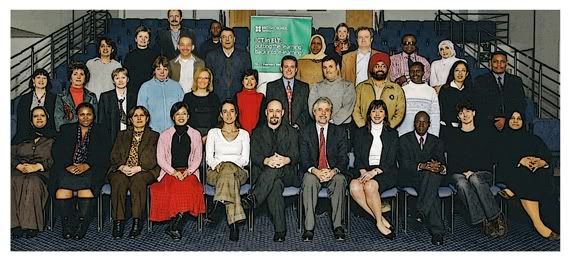 |
| Manchester Conference Center (2006) |

Subscribe to:
Posts (Atom)
