Showing posts with label EVO. Show all posts

Saturday, March 30, 2013

Giddyup (better not yell at horses): Really, it’s all about TESOL-Dallas 2013


Evelyn Izquierdo

My posts have become more and more event related (Gotta do something about it and find the time and inspiration to write more frequently). I’d like to start this post by thanking Evelyn Izquierdo, a colleague and friend, who encouraged me and pushed me to attend TESOL 2013 in Dallas (April 21st-23rd). To be honest, I always found it quite dreadful to get a visa to travel to the States. But it's me; not them. I have got to say - and thanks to the support from wonderful people - it was sort of a breeze. It could have been otherwise. A series of unfortunate events unfold the very same day I was going to have my visa interview appointment. This was doomed to be a no no travel to Dallas. But Kindness does exist (Right? Blanche DuBois).

Now the journey from Caracas to Dallas started with delays (bad weather in Atlanta airport) making our arrival there Wednesday dawn (April 20th). We got to the Fairmont Dallas hotel safe and sound, though. A few hours to sleep, and the day started with an interesting RELO (Regional English Language Office) meeting
Dallas Convention Center
with VENTESOL members and American embassy representatives (Merilu Johnson Pizarro and David Fay) in the Dallas Convention Center. In the afternoon, Evelyn Izquierdo and I checked out the room and equipment for our presentations on Thursday 21st and Friday 22nd. Ballroom A1 and two computers available for us! The name of our presentation -longer than the Amazon river: “Podcasts, web-based recordings & videocasts: Dynamic and interactive ways to provide feedback”.


Repeat please! Thursday 21st

Day to get ready for our presentation! More than biting my nails, a bit concerned about the presentation mechanics – you’ll see why. Our presentation was part of the Electronic Village and Technology showcase (CALL interest section), Ballroom A1, Dallas Convention Center.  In this event several mini presentations or workshops took place.  Each presentation (not workshops) were repeated twice. One after the other;  20 to 25 minutes each round. This gives participants the chance to listen to as many presentations as they could and maybe not missing any they wanted to attend. On each side of the room, there were about 8 presentations taking place at the same time.  Another interesting thing about this is the closeness or this sort of intimate atmosphere between the speaker and participants. Presenters were surrounded by no more than 10 participants (and even much less). For a shy participant like me I naturally felt driven to ask, contribute, comment (and that is really something). Being a participant and a teacher are two totally different things for me. The first one, I'm generally a bit shy; the second one, well I should get an Oscar nomination! Some people say teaching is like acting. Ok rambling already. 

Here’s our presentation (Evelyn Izquierdo and mine). It is based upon our experience in the Podcasting for the ESL-EFL classroom sessions 2011-2012-2013 for the Electronic Village Online (EVO)  and the feedback we gave to our participants using screencasting. The methodology we described was based upon Russell Stannard’s research and reflection on the use of digital recording to give feedback to students’ writings.

(Here's the hand-out)

What did we get from this experience? New connections and a different approach to make presentations.


Two birds and Flash Gordon: Friday 22nd, webcast

Rushing! Our presentation was scheduled for 3 p.m. Suddenly, it was changed to and earlier slot, 2 p.m.  This time it was going to be streamed in Blackboard with a live audience in Ballroom A1.  In spite of having to login to blackboard and upload presentation in a flash, it was an interesting and successful experience. All these years of online training, few webinars here and there, F2F workshops / presentations really paid off…Someone else we would have cracked up - I reckon…We did enjoy the challenge and pressure! You can check out the recording here.


What did we get from this experience? New connections, dealing with two different audiences at the same time (online/live).

Presentations: attended and enjoyed

Most sessions I attended were from the Electronic Village and Technology Showcase (who would’ve thought!). Here are my favorites:

1) Corpus-based Tools in the ESL/EFL Classroom. Magdi Kandil. Arkansas State University. Sites he shared: Wordle. The AWL highlighter, The GAP maker, Keyword extractor, The Vocab Profiler, The stringent navigator, Corpus of contemporary American English, The COCA academic Vocabulary list. If you are teaching reading or writing these sites will be gems.


2) Podcasting  for pronunciation. Jennie Brown and Roger Drury. Georgia Institute of Technology. Interesting approach using a splitter to record an interview to talk about pop culture (Music).
 

3) Creating a rubric assignment in Moodle 2.2 and 2.3. Amy Shipley. Academy of Art Uiversity. Easy way to create your own rubrics in Moodle. It might be nice idea if I decide to go LMS for my extensive reading program.

4) Using embedded Audio feedback in asynchronous online courses. Larisa Olesova (George Mason University), Luciana de Olivera and Alsu Gilmetdinova (Purdue University). It was really nice to listen to a student telling her experience on receving feedback using embedded recorded audio. It was perfect for us! We referred to this student's account in our own presentation.


5) Video to flip the English language classroom. Marsha Chan, Mission College and Sunbusrt media. An awesome character and interesting approach on working pronunciation. You have gotta to check out her PronunciatonDoctor: 


Some other interesting presentations I attended outside Ballroom A1: Equipping visually impaired ESL learners with the language to thrive ( Pamela Marcus and Timothy Farnsworth. Hunter College) and ESL writing in a flipped classroom (Jhon Graney, Santa Fe College). Here are my favorite slides from these presentations. 
Pamela Marcus and Timothy Farnsworth. Hunter College

Jhon Graney, Santa Fe College
Claudio Fleury and Lilian Marchezoni, Casa Thomas Jefferson
As for the EV miniworkshops I attended: "How to design PowerPoint presentations for a Student-centered approach”, Claudio Fleury and Lilian Marchezoni, Casa Thomas Jefferson. Lilian showed how creative you can be when using PowerPoint to create games for practicing speaking, grammar and vocabulary. I also participated in the workshop "Achieving oral fluency with dynamic PechaKucha prezis”, Marsha Appling-Nuñez.

Happy to see how creative presentations were using desktop / laptop based activities apart from mobile technology (Ipads, tablets, smartphones). Unfortunately, missed presentations about games and ELT.


Nina Liakos

My PLN and others

After our Thursday presentation, Nina Liakos, Webhead member, treat us to lunch at an Italian restaurant. Nina enrolled in our EVO session Podcasting for the ESL-EFL classroom session back in 2011 and  she became our mentor in the same session this year (2013). What an honor! We had a delightful and fun conversation at Ravenna restaurant  close to the Dallas Convention Center. I also met Elizabeth Hanson-Smith, Webhead. She attended part of our webcast session in Ballroom A1, Friday 22nd. Nice lady! I also met Vance Stevens, founder and moderator of the Webheads community of practice and Nelly Deutsch (Webhead). It was also nice to meet Claudio Fleury, Snea Thinsan, Mary Hillis and Phil Hubbard.


Left to right: Evelyn Izquierdo, Nina Laikos, Roger Druri, Chris Sauer, Snea Thisan, Claudio Felury, Vance Stevens, Phil Hubbard, Nellie Deutsch


It was great to see VENTESOL board members in this conference: Luisa Cristina Alvarez (President), Evelin Ojeda 1st Vice President, Mary Allegra 2nd Vice President, 3rd Vice President Jesús Ernesto Lisboa and Grazibel Nani Treasurer. Also, it was a real pleasure to have met our flight mate, Chinger Zapata (UPEL-Barquisimeto)
Left to right: Luisa Cristina A., Mary A., Evelin O.,  Ernesto L., Grazibel N., Evelyn I.
To end this experience-event-summary, it goes without saying that meeting so many other EFL-ESL teachers was really valuable; strolling a bit around the hotel or the convention center was really nice- OK, Evelyn dragged me out of my comfort zone most of the time. My plan was heading to the convention center early morning, back to hotel in the evening – Boring- yeah, I know. Hadn’t done this, I wouldn’t have met a fun Vance and had a short ride by train. 

BTW, we did see horses (carriage rides)…But no Hollywood giddyups were heard!


All images: Miguel Mendoza by Miguel Mendoza is licensed under a Creative Commons Attribution-NonCommercial-NoDerivs 3.0 Unported License

Thursday, February 16, 2012

Reflections/Overview: Podcasting for the ESL-EFL Classroom. 2011-2012

This is the second year in a row that I co-moderate the Podcasting for the ESL-EFL Classroom session.  This is one of 13 free teacher training sessions offered by the English Village Online (EVO) this year. This year I had the pleasure to share the co-moderation with Evelyn Izquierdo and Teadira Pérez. In 2011, I co-moderated it along with Evelyn Izquierdo and José Rodríguez. 

This session aims at providing basic notions and tools to:
1.    understand what podcasting is
2.    create podcasts the easy and difficult way (Stanley, 2006)
3.    become familiar on ways to use podcasts in the ESL-EFL classroom
4.    create a podcast project

The session is addressed to beginners or - as we have noticed- to teachers who are familiar with tools like Audacity but have never succeeded in using it since, it seems to be, they are daunted by its sometimes unfriendly interface, apparent threatening look or complicated layout.  At the end of the session, they realize how easy it is to use and they can get hooked to this free software to create simple but very creative and almost professional podcasts.

EVO sessions run for five weeks from January to February. The Podcasting for the ESL-EFL Classroom uses as a major platform the old, but really helpful and reliable Yahoo Groups. We use it to communicate, announce the start of each week session, answer participants’ queries and welcome newcomers. We also use it, as part of tasks, to share recordings and blogs as well as to keep a record of participants’ information and photos. The other platform we use is Blogger for the Session blog, the Activity blog and the reading blog. Participants use Blogger to create their own e-portfolios.

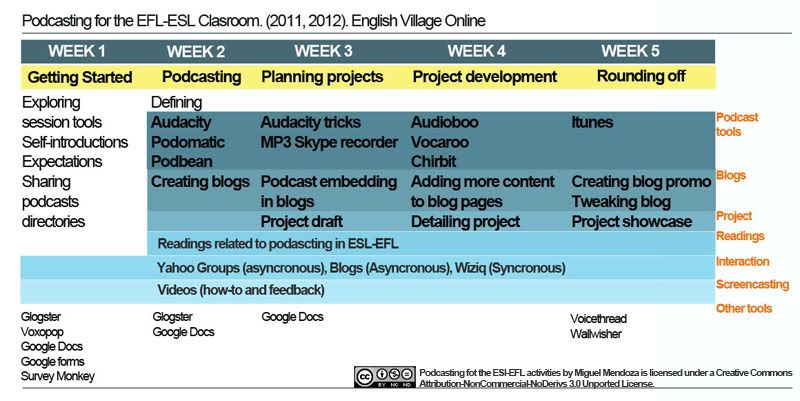
Activities or tasks have been planned in a graded manner, step by step sort of approach, to help participants become familiar with Audacity (the difficult way – Stanley, 2006) along with web-based podcast services (the easy way- Stanley, 2006). Creating blogs start from Week 2 all the way up to Week 5 when participants showcase them in the Podcasting Fair in Wiziq. Readings also start from understanding basic notions related to podcasting, how it is used in ESL-EFL (Weeks 2-4) and reviewing a pool of websites about podcasting collected by Wesley Fryer (Week 5). Furthermore, tasks are planned to try to encourage participants to work on their own without depending that much on the moderators especially after Week 2. Tutorials come in handy to explore and learn all the tools introduced all along the session. They are also used to clarify certain technical problems participants report in the Yahoo groups.  Here’s a quick overview on how the content is organized for this session. (Click on image to enlarge).


You can also here to read a description of each activities done during each week.


One of the things we have learned while moderating this session is that we should take into account:

1. Operating systems (e.g. Linux,  Windows, Leopard)
2. Browsers (Internet explorer, Firefox and Google Chrome)
3. PC and Mac users
4. Participants’ IT skills or expertise
5. Best time to plan synchronous sessions in international teaching training development sessions like EVO
6. Moderator’s support (e.g. immediacy , close support)

As for the evaluation, participants from the 2011 session talked about:

1. Variety of podcast tools
2. The support of  tutors and colleagues
3. Moderators’ Immediate response
4. Challenging course design, but achievable activities
5. Well-planned and selected activities per week
6. Progression of activities (from easy to demanding ones)
7. The potential of some other tools used in the session like Glogster, Blogger, Google docs, Voicethread among others
8. The use of tutorials to provide support and feedback
9. Confidence  to show other students and colleagues how to use podcasts
10. Having access to their own blogs (e-portfolio), session blogs and Yahoo groups even when the session is over.
11. Valuable synchronous sessions focused on review and not on empty chatting.
12. Broadening participants’ knowledge on podcast tools some participants thought they knew well.

Participants from the 2012 session talked about:

1. Their favorite tool being to our surprise Audacity. One of the participants, however, reported it is not advisable to use by young learners since it might be a bit hard to master.
2. Some other favorite podcasting tools like  Audioboo, Podmatic and Podbean.
3. Challenging course design, but achievable activities. Some participants suggested advertising it as a class.
4. Offering a session on videos as the natural next step after podcasting. They especially liked the video tutorials and how they showed a step by step way to create podcasts.
5. The potential of some other tools used in the session like Glogster, Blogger, Google docs, Voicethread among others
6. Well-planned and selected activities per week
7. The support of  tutors and colleagues
8. The follow up made by tutors on participants’ work each week
9. Progression of activities (from easy to demanding ones)

As for the moderators’ feedback, it was done using screencasting. This feedback is generally given during Week 5 before participants showcase their work. It is advisable to do this to provide this boost of confidence participants need before showcasing their work in a live session. This feedback consisted in reviewing each page from the blog’s participants providing advice on adding missing information and podcasts and the project itself. 

Watch this feedback for one of the participants from the 2011 session:


Watch this feedback for one of the participants from the 2012 session:


For a future session we should include some other tools like Sound Cloud and refer to the use of mobile technology to record podcasts.


Here are some participants' podcast samples made during 2011 and 2012:


Podbean (First recording using Audacity)

About me: Chris Jeffries (2011)


About me: Kerry (2012)


Podomatic:

Out my Window: Barbara Sakamoto (2011)


Out my Window: Janet Bianchini (2012)


MP3 Skype recorder:

Interview: Nina Liakos (2011)


Interview: Steve K (2012)


Audioboo

My mystery person: Maryanne Burgos (2011)

Canadian Mystery Person (mp3)

My Mystery person: Natasa Bozic Grojic (2012)

My Mystery Person (mp3)

Vocaroo

Recordings for the 2011 session are not available.

Questions to e-moderators: Sophia Danesino (2012)


Chirbits

Tongue twister: Jhon Conway (2012)


Tongue twister: Marie Helene (2011)


Blog Promo

Yuly Asención(2011)


Maja Dakic-Brkovic (2012)


Here is a participant' podcast blog (e-portfolio) from 2011 session:


Here is a participant' podcast blog (e-portfolio) from 2012 session:


To check out more great participants' blogs and podcast I invite you to visit the blogs for 2011 and 2012 sessions.

Related Posts Plugin for WordPress, Blogger...